
News
Key Information:
- Prolonged UV exposure can cause decking to fade, dry out and deteriorate over time, particularly with timber and lower-quality composite products.
- High-quality composite decking with UV stabilisers and a fully capped surface (like NexGEN PermaTech®) is designed to maintain colour and performance in full sun.
- Material quality, board colour and deck design all influence how well decking performs in sun-exposed outdoor environments.
Many Australian decks are exposed to intense, all-day sunlight – whether that’s in open backyards or sun-drenched coastal areas. If you’re not careful with your choice of materials, constant UV exposure can impact colour, surface condition and long-term structural performance.
Choosing the right decking means balancing the desired appearance with how well the product performs long-term in Australia’s harsh outdoor conditions.
What UV exposure does to decking over time
Prolonged UV exposure can gradually break down the surface of your beloved backyard deck. On timber or uncapped composite decking, this can lead to fading, surface drying, and degradation over time.
UV resistance varies depending on the material composition and manufacturing quality of your decking. Lower-quality composite decking often lacks the stabilisers needed to maintain colour over time; your deck may end up looking quite different after a while.
Timber vs composite decking in full sun
Timber is a natural material that is highly susceptible to UV-related changes and damage. Even if you are prepared to do ongoing maintenance, timber decks in sunny environments commonly face issues like:
- Fading or greying (some may enjoy the ‘silvering’, but it is ultimately a sign of weathering).
- Surface cracking or damage.
- Inconsistent colour – particularly in shaded vs non-shaded areas.
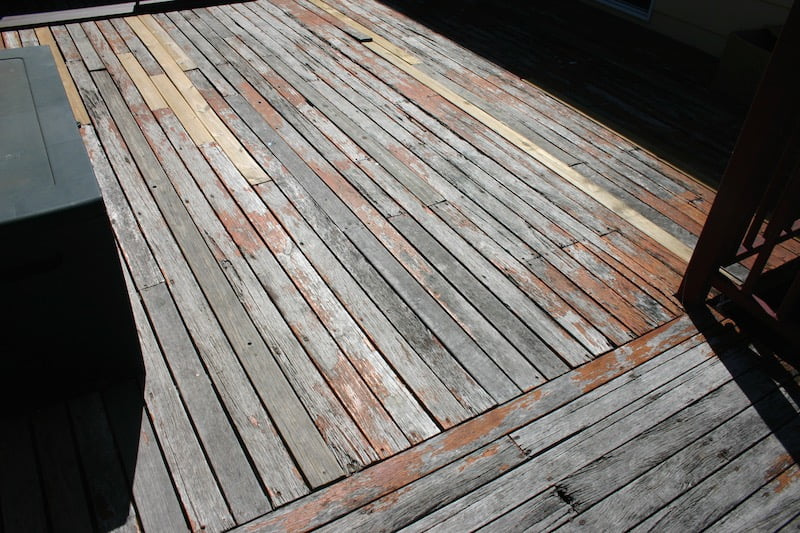
Timber decking can degrade under intense UV exposure
Composite decking under UV exposure
Composite’s advantage lies in its day in, day out durability. Compared to timber decking, composite decking is much more durable. Composite boards have a greater resistance to fading, a more consistent appearance over time, and don’t need sealing or oiling as a protective measure like timber.
However, even within the options available on the market today – not all composite decking performs equally.
Related: Capped vs Uncapped Composite Decking Explained
How quality impacts performance
Composite decking boards can have significant variation in construction, surface technology and overall quality. Look for things like:
- UV stability and fade resistance.
- Proven dimensional stability (against excessive expansion, contraction or warping) during temperature swings.
- Protective surface technology: choosing fully capped composite boards such as PermaTech® provides additional protection against staining, fading, moisture, surface damage, and pests. Partially capped or uncapped products don’t offer the same level of protection as fully capped composites.
- Long-term durability and ultra-low maintenance: you want your composite decking to last longer than timber, with less effort on your part. Look for products with strong guarantees and warranties to cover decades of use.
Watch below: NexGEN Composites PermaTech® Explained
Managing UV exposure and heat on your decking project
Even with the best materials, most decks will still be exposed to UV and heat throughout the day – meaning they will get hot in summer. Thoughtful design choices help reduce this exposure and make outdoor spaces more usable during peak summer conditions.
1. Add partial shade over the deck
Areas in all-day sun (typically north-facing) or afternoon sun need more consideration because they will have the full force of the sun during peak UV and temperature hours.
Pergolas, shade sails, outdoor umbrellas or even trees nearby do more than just provide a shady place to sit – they help to reduce direct sun exposure, keeping your decking more protected than it would be otherwise.
2. Choose lighter colours where possible
All materials will absorb some degree of solar radiation and store heat; darker and denser materials generally absorb more heat from the sun than lighter, more reflective surfaces.
If you’re using timber or a cheaper composite that isn’t specifically designed to resist UV fading, you will likely notice fading a lot faster on a dark coloured deck as well.
Related: Composite Decking Colours 101: Everything You Need to Know!
3. Allow for airflow
While you can safely and easily build a low profile deck with products like DeckCell without risk of rot or rust, allowing for greater airflow under your deck will help keep it cooler by dispersing trapped heat on hot days.
4. Add a rug as a physical barrier
Outdoor furniture and rugs create literal barriers between UV rays and your deck, but also between your deck and your skin on a hot day. This can be a quick fix if you need to utilise more space on your deck.
5. Wear footwear on hot days
Sometimes, there’s no way around it – your decking will absorb heat, and it won’t feel pleasant underfoot. The easiest way to avoid accidentally stepping on a hot surface is to wear shoes and avoid directly touching it when ambient temperatures are high.
NexGEN is made for Australian conditions
Your deck is an investment. Choose high quality composite decking that’s designed, manufactured and tested to perform year after year in harsh Australian conditions.
NexGEN’s PermaTech® capped composite decking is a hardwood-filled, fully capped composite product that’s easy to install, and even easier to maintain. PermaTech® products have a protective outer layer guaranteed to resist UV degradation, staining, moisture absorption, pests, and won’t warp, rot, splinter or scratch even with heavy use.
Achieve the deck of your dreams with realistic natural wood grain textures and colours inspired by Australian hardwood timber – and better yet, you can enjoy it for a lifetime with our market-leading stain, fade and structural warranties.
Request a free sample pack below, or contact us today to get started with your decking project.
Products
Gallery
Contact
Direct Office Numbers
Adelaide – (08) 6316 0469
Brisbane – (07) 3041 6065
Sydney – (02) 8072 6220